
June Rain - On Process, Publishing and the Fear of Being Seen
A few things I have learned.

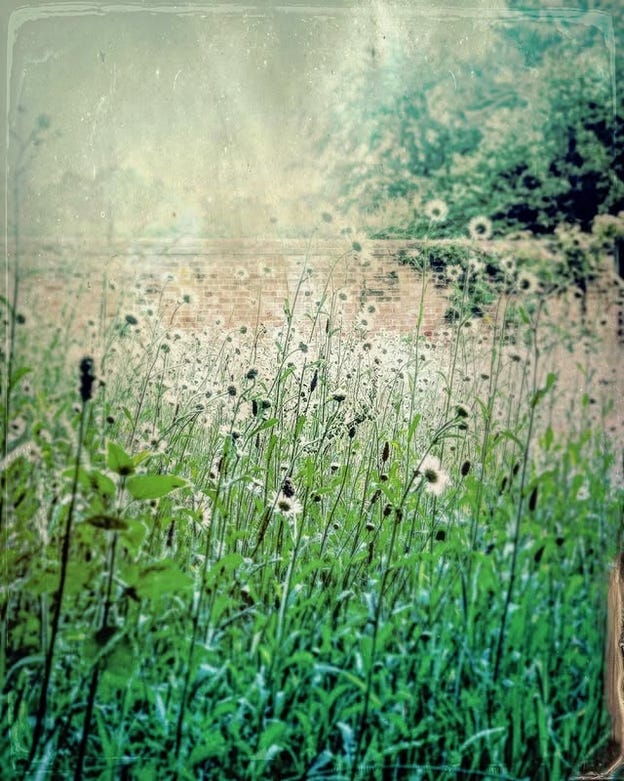
After a warm, dry May when the grass was already starting to brown and the trees were beginning to darken like they usually do in late July, the first week of June brought some much-needed rain.
It came in a deluge accompanied by thunder and lightning. I hadn’t known how much I needed it until it arrived.
Big round globs splashed the garden. It felt glorious, and smelt divine. Water gathered in spheres on the leaves of sweet peas and nasturtiums, the tree canopy and hedgerows danced in the downpour, and elderflower blossoms tumbled to the ground in galaxies of tiny, cream-coloured stars.
Rain fell on the back field, releasing the scent of freshly mown hay. Rhododendrons spread their branches out. Water flowed in rivulets on voluptuous petals. The ox eye daisies lay down and had a good drink.
I recently had a spate of good writing news, including the signing of two publishing deals in the space of a month. It makes me ridiculously happy to write that sentence. It also fills me with a good sort of fear.
The first contract was for my children’s book, several years in the making. I cannot wait to share this project with you. I absolutely love it, and can hardly believe it’s real.
The second was for a collection of essays and poems. This collection is without doubt the most vulnerable work I have ever done.
I’ll take the fear as a good thing. It’s usually a sign of growth.
On quietude
I am generally more interested in reading people who are immersed in process than I am reading about people’s publishing wins. I have a lot of respect for those who share from the messy, imperfect, vulnerable places in their work, and I try to do this in my poetry.
However, there are times when it’s appropriate to give creative projects time to gestate before releasing them into the world. I had an instinct to not talk about this book too much until it was out of the embryonic stage, and had a shape and energy of its own.
I knew on a deep, intuitive level that the writing needed to happen privately. The only way to get it written was to get quiet and do the work.
After holding it all so close for a long time, it feels good to share a little of the process. If you’re interested, read on…
Into the writing cave
I wrote this book in the margins where women and mothers have always created, around children and paid work and unpaid domestic work and the myriad other ways that we offer ourselves to the world. This is reflected in the work. In many ways, it is the work.
Most of the book was written on top of my washing machine, in my cluttered kitchen where my laptop lives. As well as being a fitting metaphor for life as a creative mother, the machine also kept me warm in the winter when the tumble dryer was on, and is right next to the kettle, which is handy.
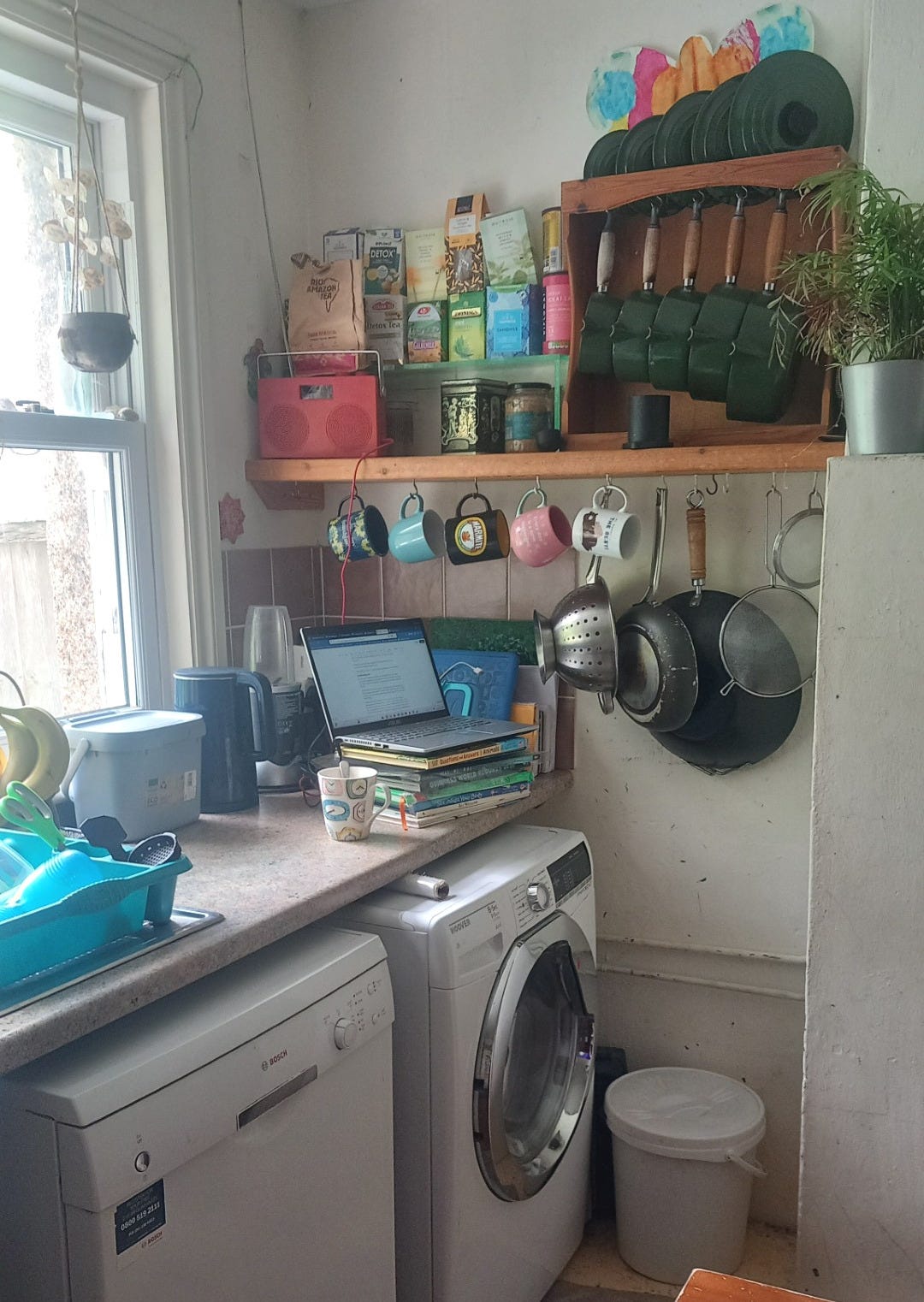
As much as I could, and despite the humdrum appearance of my work station, I romanticised the living daylights out of my practice. I got up early, lit candles, wrapped myself in blankets and wrote on the sofa. I wove as much softness through it as I could, wrote with a glass of wine while I was making dinner for the kids, wrote in the car, made notes in bed, read books that inspired me. This wasn’t purely for pleasure. It was a matter of survival. If I didn’t make the writing joyful in some way, the book would never exist.
I procrastinated. I doubted myself often and somehow kept going. My husband’s belief in me, as always, far surpassed my own.
From around the start of 2025 onwards, I tried to wean myself offline and focus on my manuscript. This wasn’t easy, but it was a necessary, radical shift in my practice. Some of the poems in the collection have been shared online, but all of the long form writing and a lot of the poems are previously unpublished. I am not advocating this as the best way to do things. It’s just what I felt needed to happen.
Creative work can be a gift during times of uncertainty. Over time the book became a kind of life raft. It took up a huge amount of space in my head. It ended up carrying me through some incredibly fractured, uncertain, grief-stricken, hope-filled years. This, too, is reflected in the work.
By late last year, I became obsessed and stubborn enough (as in, more so than usual) to see the thing through to the point where it resembled something like a book manuscript. Something like what I wanted to say. Not a perfect thing - because you can always do more - but something imperfect, honest and complete.
Something good enough.
On publishing
I hoped that the small, independent publishing scene was the right home for my work. Indie presses are usually run and staffed by lovely people who are genuinely passionate about books and writing. Their websites are typically warm and approachable, their submission guidelines tend to be simple and accessible, and they rarely charge reading fees which I don’t have the budget for.
I figured that if I didn’t have any luck finding a publisher, I would self publish. Both approaches have their merits, but having traditionally published my first collection, I wanted the editorial, distributional and promotional support, and yes, the validation of a publisher. There are few things like other people believing in your work to make you believe in it yourself.
I read articles about whether I should approach presses directly or attempt to sign with a literary agent first. In the end I pitched one dream agent, who politely declined, and decided to focus on submitting straight to publishers.
I read a ton of articles about how to write a good cover letter. The best piece of advice I found in any of these articles was not to worry too much about making it pitch perfect, because the main job of a cover letter is simply to give the publisher an idea of what the book is about.
Naturally, I ignored this advice and completely stressed myself out trying to write a perfect query letter. I did not enjoy this (I’m happy to share the letter with anyone who feels they might find it helpful in their own publishing journey; please just ask).
Luckily, within weeks, one of my moonshot publishers got got back to me with an acceptance. It all happened fast. I was overjoyed.
I feel incredibly lucky. I also gave this collection everything I had. I also believe that some things happen at the right time.
And now the thing I have held so dear and so close for so long becomes something else entirely.
On vulnerability
There is a difference between sharing your soul through your art — which is a brave, generous and achingly human thing to do — and mining your trauma to create content. It is your job alone as an artist to discern that difference.
By the same token, the job of an artist is also to be fully expressed. I am more and more convinced that when we share from a place of vulnerability and emotional honesty, the right people will find us.
I feel tremendously vulnerable in sharing this work. But something tells me that’s where the good stuff is. I have tried very hard to strike a balance between creative courage and emotional safety - because have you ever read a good book or listened to a piece of music and thought “I’m really glad this artist played it safe, didn’t offend anyone and remained guarded around their self expression?”
Nope.
And these, my friends, are no times for half measures.
On marketing, for people who hate marketing
Being accepted for publication is just the beginning. It’s a bit like reaching the top of a hill and having a mountain come into view. There is editing to be done, and then the part that not many (any?) authors enjoy: marketing.
I admire writers who promote their work in ways that feel authentic to them, rather than doing whatever the next social media strategist or online coach is telling them to do. I think readers respond to integrity, too. Everyone’s a bit tired of all the noise.
Book marketing will always be a huge challenge for me. I find loud, competitive social platforms inhibiting and anxiety-inducing, and have never been much good at ‘gaming the algorithm’.
I think of my creative self as being rather child-like and deserving of protection. Deep down I am a bit worried that I won’t be able to “get out of my own way” and showcase my book as much as other artists seem able to, that maybe I don’t have what it takes to do that part of being an author. But I care enough to give it my best shot.
Underneath all this, of course, are deep wounds around being visible, being needy, and being heard. I have survived a fair bit of emotional abuse and monitoring by people who do not wish me well (yes, I know this is weird) in my time, so putting my writing on display requires extra levels of shadow work. It’s also probably why I had valid reasons to wait until my book dream was properly formed before I felt ready to share it with anyone.
With that said, I want my books to do well! And marketing, like it or not, is part of the job. I will have to push through some discomfort to put myself “out there” - in the real world, as well as online - but for us sensitive types, I believe it’s possible to challenge ourselves to show up for our creative work with gentleness, honesty and self compassion, without overwhelming our nervous systems by feeling excessively exposed (I mean, that’s what the book is for, right?) and without reducing ourselves to being good little servants of the capitalist tech bro overlords.
When the work of writing deals with your interior life, as it so often does, and then does a complete flip where it becomes a product, the lines between showing up for work and turning the contents of your soul into a personal brand can become blurred. This is something everyone navigates differently. My advice - not that anyone asked, lol - would be to focus on the work. Have the courage to be truthful. Remember your only real competition is with yourself, and when you’re ready, reframe sharing it as an act of generosity rather than one of self promotion.
In short, do you. Your work may be just the thing that someone else needs to find.
My favourite word on social media, from Martin Shaw’s brilliant book Smoke Hole: Looking to the Wild in the Time of the Spyglass, is that we must treat it as “a tool, not a god.”
It’s another day of brooding skies here. Rain dripping from jade green leaves. The garden is lush and lovely and alive, trees and seedlings dancing in wild June winds, birds hunkered down in feather-lined nests. I’ve been feeling a bit tired and boggled this week, so I’m taking a moment to let it all soak in and settle.
On this light-filled bridge between Beltane and the midsummer solstice, after being focused on book work for a long time, I’m looking forward to bringing some lightness, ease and spontaneity back into my practice. I’d like to explore working in community and having some fun. I’m already thinking about writing a novel (why are we like this?).
Mostly, I’d like to get quiet enough to start writing poetry again. I’m a little anxious to admit that I’ve been in a creative lull since finishing the book. I suspect this is normal after completing a years-long project, but I hope poetry comes back to me, and I know the best way to invite it is to create space for rest, play, and time alone. This, too is a challenge. Life is busy.
I hope you’ll join me as I take the bumpy ride from writing quietly in my kitchen to releasing books into the world. Maybe one day, I’ll have a desk! Thank you so much for being here. Truly, it means everything.
love Caroline x
My second full collection of poetry and essays, River, Moss, Moon, will be released with The Poetry Lighthouse in 2027.
If you’d like to support my creative work, the very best way to do this is through a paid subscription. I am grateful for every single subscriber and follower, but the little boost into my bank account from paid subscriptions really makes a difference. Ta x
Beautiful piece Caroline and congratulations on your wonderful publishing news. Your discussion on the tension between vulnerability and privacy definitely resonates. Thank you for sharing 🦋
Congratulations Caroline, It's so exciting to hear of your success. I'm absolutely here for the releasing of your books into the world!